Wednesday, 10 June 2020

The hazards of Bees and Negligees

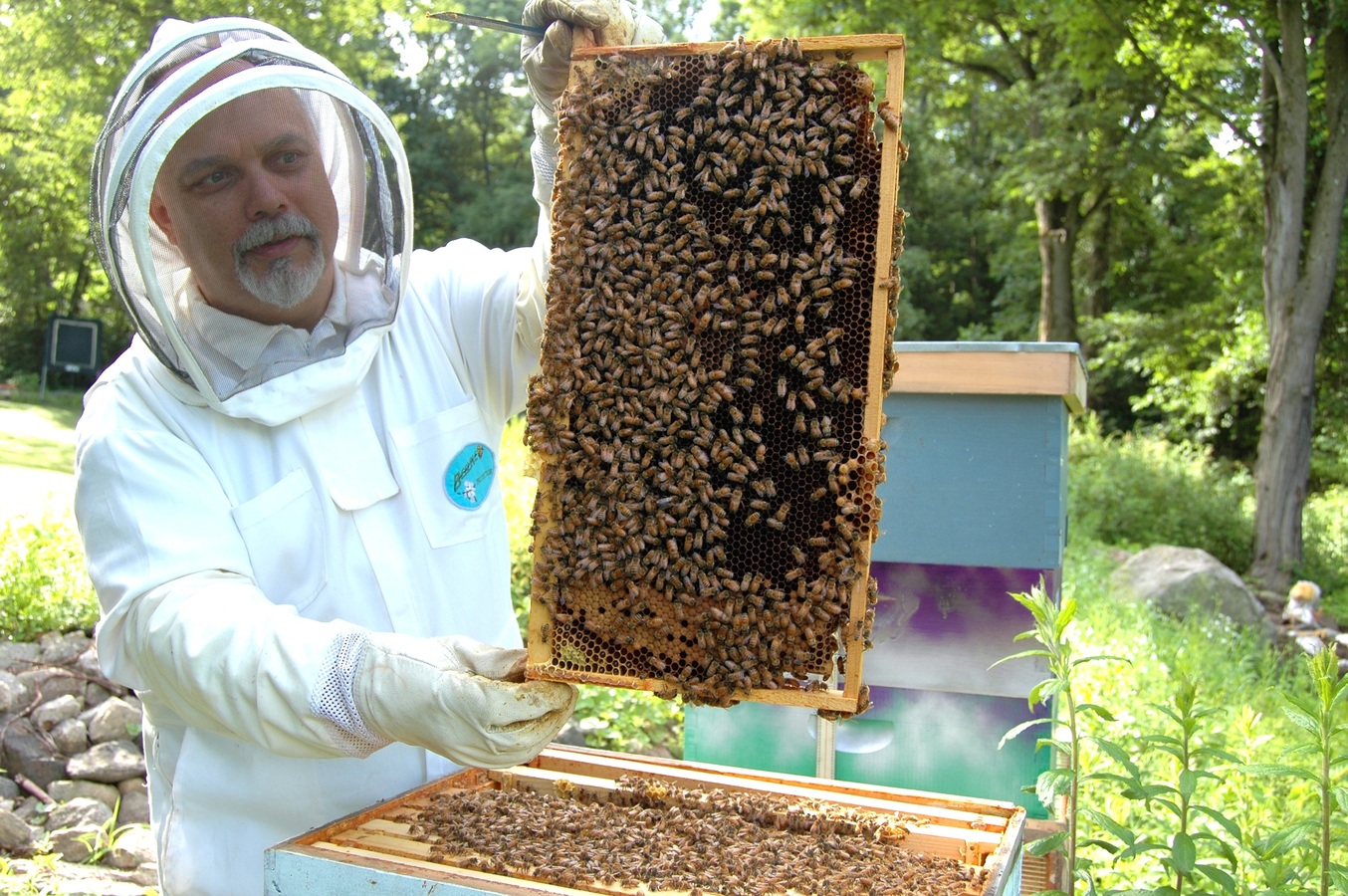
Bill was finding that a beekeepers callouts invovling bees and ladies in negligees could be more difficult than expected!

The hazards of bees and negligees
Extract from chapter 9 of Bill Clark's autobiography, Route and Branch, podcasts of his book. Recording available here: https://archive.org/download/bees-and-negligees/Ch9d-Bees-and-negligees.mp3

I believe it is important for all beekeepers to dash and help members of the public who have a problem with bees – if the beekeeper is able. For most people, a swarm is an alarming circumstance, and by taking the swarm, the beekeeper is indeed their ‘knight in shining armour’. Picking it up promptly prevents it from choosing a new home in such as a chimney, and causing even more alarm, thereby giving bees and nearby beekeepers a bad name. Above all, it is important to save the bees, and get them into a beekeepers care, for seldom do more than one in three swarms survive in the wild.

Of the hundreds of swarms and established colonies I have dealt with, I have only had to kill two lots. One was my first Wimpole Hall incident. It was the Easter holiday, the season’s first opening of the house, and the housekeeper had entered to find bees everywhere. It was an early call, with my own busy day about to start. ‘Is there anything at all you can do Mr Clark, we shall lose thousands of pounds if we have to keep closed.’ Upon my arrival I found three rooms full of bees. They were coming down two, back to back, chimneys. I asked for old blankets, and an industrial vacuum. After stuffing up the offending chimneys above the fireplaces, I whizzed around the rooms sucking up bees with the vacuum. The last bee was going down the tube, as the first visitors walked to the door!

One call was from the ambulance station at Addenbrookes Hospital. ‘There is a large swarm hanging in the leylandii hedge outside our front entrance.’ I unloaded my swarm box, stopping briefly to pull hat and veil over my head, then shook the hedge vigorously over the open box – praying that the queen had fallen in. With the lid replaced, box and I smothered in bees, I moved it from the hedge a few paces. After opening the entrance, I stood up to watch events, and realised that a row of shocked looking faces were peering out of the windows, and I hastily held up both thumbs to indicate all was well. Within moments bees were leaving me, to enter the box, as more and more fanned out their pheromones denoting the queen was inside. Soon afterwards, free of bees, I called in to say I would return that evening, to take the box away – receiving a round of applause.

One swarm-collecting foray brought the colour to my cheeks! Wendy had told a lady I could only get there late in the evening, and on arrival I walked round the back as instructed and knocked on a door, whereupon it was opened by a housekeeper type lady, who said she was just leaving, but that I was to go up the stairs, and knock on the second door on the left. Swarm box in hand, I climbed the carpeted stairs and knocked, and upon hearing a chirpy ‘Come in Mr Clark,’ walked in. Finding myself in what I can only describe as an OTT lady’s bedroom on an American film set! Sitting up, surrounded by silk covered pillows, was a buxom lady of about 60 years, in an extremely revealing black silk negligee. If it wasn’t for the fact that I could see bees flying around the open window, I would have fled.

As nonchalantly as possible I walked over to the window. Although there was no swarm, I could see one had been there by the flecks of wax on the pelmet. I placed my hand out on the tiled roof still baking hot from the sun, turned – the negligee was now covering even less – and said, ‘The swarm has left, these few bees will return to their original home shortly. What happened is that they went up into the casement roof to live – probably yesterday – but today’s hot sun roasted them out and they have gone to find another home. It would be a good idea to get a handyman to block up the hole before another swarm arrives.’ ‘Oh Mr Clark, you are so clever, I love listening to you on Radio Cambridgeshire.’ She patted the coverlet, ‘Come and sit down and tell me more.’

I said I would love to stay and chat, but unfortunately there were more swarms waiting – and escaped from the room!

Chapter 10 continues with cowslips returning to the picnic field https://routeandbranch.blogspot.com/2020/06/cowslips-return-to-picnic-field-at.html

Tuesday, 9 June 2020

Birders at Wandlebury and the Icterine Warbler

Wandlebury was becoming polular with birders. The arrival of an Incterine Warbler drew a flurry of attention - but was it one? A big debate ensured.

Icterine Warbler. photo Artur MikoĊ‚ajewski (Wikipedia CC-BY-SA)
Extract of a reading of 'Route and Branch' by Bill Clark. Full podcast available here:

The local RSPB members especially, raised funds and made up work parties to help clear gale damage and plant trees and shrubs. Their blackberry and wild rose plantings to block off some of the miles of unofficial paths, not only raised the numbers of nesting whitethroats and yellowhammers, but as the bare areas behind filled with grasses, nettles and thistles, the number of woodland ground-nesting birds, such as chiffchaffs and willow warblers went up. 

Another important factor was the extra eyes and ears, for although I tried to cover most of the estate each day, with all my other work I could not hope to know all that was happening. It is not surprising that they listed some 80% of the interesting or first of a season’s migrant birds – on occasion almost getting me out of bed to rush off with them! Common Buzzards, Bramblings, Golden Orioles, Great Grey Shrikes, Honey Buzzards, Nutcrackers, Peregrine Falcons, Pied Flycatchers, Redstarts, Ring Ousels, Rock Partridges, Spotted Flycatchers and Wheatears – even my old friend the Osprey passing overhead – to name but a few. If a bird visited Wandlebury, there was a good chance it would be noticed.

Their finest hour – to get them national recognition – was the morning of the 24th of June, when CBC member Dr Rathnell knocked on my door to inform me that an Icterine Warbler was singing near the car park. I was pleased by this, because on the 16th, I had heard strange warbler song: but upon returning with my books and binoculars, I heard it no more. I walked down with the excited Doctor and we stood listening and confirming with our books. The next few days brought a trickle of bird watchers and I thought that I should prepare for a flood! Fortunately Carl pitched in – he was nearly as excited as Dr Rathnell – and warmly met and conversed with the ‘twitchers’, but looked askance at my unusual reticence. I told him of my past problems with the Osprey at Wivenhoe, and that we must have ropes, posts and signs, ready for the worst.

By the 30th, the constant attendance averaged a score from dawn to dusk. Very conveniently the bird spent most of its time in a couple of spindly ash saplings – the only tall trees left on the north side of the car park – all the birders had to do, was park, set up their telescopes and cameras, and watch. Unfortunately there was an argument raging and this was bringing in even more punters: most thought it was an Icterine Warbler, whilst others argued for Melodious Warbler. I suggested it may be a ‘Meloderine Warbler’ – receiving some pitying glances. 

On the 1st of July, Carl and I were waiting in the car park for a school bus, and I remarked, ‘Someone of consequence is about to arrive, see how the twitchers are all looking at every car that turns in the gate.’ Sure enough, minutes later a car drove in and parked among them, causing some cameras to turn towards the car! 

The ‘royal’ personage stepped out, gave a smile and a nod towards all and sundry, lifted his car-boot lid, and proceeded to fit telescope to tripod. I muttered to Carl, ‘Try and find out who he is,’ for by then I was no longer on the twitchers Christmas card list, having forbidden them to enter the woodland to search for a nest. Our bird was pouring out its song almost directly above the great man, as he leaned back in the car and retrieved a camera, hanging it around his neck before straightening up and swinging round. With a broad smile, he called out, ‘Good afternoon everyone, has anyone seen it yet?’ Carl was not at all impressed, especially when he learned the man was the editor of a prestigious bird magazine!

On the 7th of July, Rosemary Jellis, the author of ‘Bird Sounds and Their Meaning’, arrived to play some recordings to the bird – it was still singing non-stop – and she confessed she didn’t recognise the song purely as one or the other. It completely ignored a Marsh Warbler’s song – stopped singing briefly at the sound of a Melodious – but upon hearing the Icterine, dashed down and flew at the loud speaker, before agitatedly hopping from twig to twig around it. After a second playing gave the same results, Rosemary switched off the equipment: ‘That settles it, it’s definitely an Icterine.’ But it was not cut and dried! The ‘experts’ were measuring the tertials, primaries and scapulars on their close-up photos, coming down on the side of Melodious: whilst others compared photos of Icterines, and argued for the wing length, leg colour and wing panel colours. 

Perhaps it was fortunate that the bird left us before there was open war, or the suggestion that it should be captured. Later, when a draft of an article was sent to me by the ‘British Birds’ editor, for my approval – I was amused to read the hypothesis, ‘the possibility that it was a hybrid Icterine x Melodious Warbler, however, might tenuously be suggested.’

The readings continue with the hazards of bees and negligees https://routeandbranch.blogspot.com/2020/06/the-hazards-of-bees-and-negligees.html

Sunday, 7 June 2020

A young helper and Wendys suspect pot plants

New young volunteer Richard justifiably has concerns about Wendy's pot plants!

Cannabis sativa leaf. photo Lode Van de Velde 
Extract from the podcasts of Route and Branch, autobiography of Bill Clark, former Warden of Wandlebury: full recording available here:
https://archive.org/download/young-helper/Ch9b-Young-Helper.mp3

Richard boarded with an Aunt, and occasionally had holidays with his father who worked in Jamaica. After one – lasting some weeks – he arrived back, and finding Wendy busy in the greenhouse, immediately asked where I was working, but still hung around, acting as if on ‘tenterhooks’. She asked if he was well. ‘Of course I am well, whatever makes you think I am not,’ was the indignant reply. Wendy persisted, ‘Richard, if you are worried about something, I am sure we can help.’

Richard shuffled, his face colouring up, ‘Well actually, I was wondering why you are growing cannabis?’ Wendy now coloured up, and pointing, said, ‘Oh good gracious, do you mean that row of plants?’ Richard looked even more embarrassed, ‘Oh dear, Bill hasn’t told you!’

I had found fifteen pots of tiny plants and a trowel hidden in the undergrowth one showery afternoon, and assumed it was the work of some well-meaning person – other garden flowers had been planted around the new trees from time to time. Not recognising these, I had asked Wendy to plant them in the garden. ‘They must be something exotic,’ I had remarked.

Wendy sent Richard ‘hot foot’ after me. I jogged back beside his bicycle; Richard apologising profusely for causing such a kerfuffle, and surmising – although he had seen the plants all over Jamaica – that he could be wrong. At home – looking in the correct book – we could see the now quite large and handsome plants, were indeed cannabis.

I looked aghast at Wendy. ‘Can you remember if any policemen have driven round here since you planted them?’ Neither of us could be sure, for they came fairly regularly. Not always because of Wendy’s 999 calls, sometimes bringing information, or hoping for some, about local, ‘bad lads’ – and also, just in case Wendy had her celebrated honeyed scones in the larder.

It was no good, I couldn’t take the chance and just burn the plants – we could already be under surveillance – I would have to phone up and confess. It quite amused our local bobby, but to Richard’s anguish, the ‘Narcotics Division’ still arrived with sirens wailing and blue lights flashing.

Readings continue with Birders at Wandlebury and the Icterine Warbler https://routeandbranch.blogspot.com/2020/06/birders-at-wandlebury-and-icterine.html

Saturday, 6 June 2020

Beekeeping as a beginner

Fulfilling a life long ambition, Bill Clark tells the story of how he became a beekeeper at Wandlebury

Beekeper with open hive and comb. photo pxhere

Extract from the podcast of beginning beekeeping by Bill Clark, former Warden at Wandlebury. Full  podcast here: https://archive.org/download/beginners-beekeeping/Ch9a-beekeeping.mp3

...On the following Wednesday, I happened to see some boys pushing over four hives in a nearby field. I arrived to find live bees in one, and a sheet of paper with the name and phone number of the beekeeper, among the debris of one of the three containing only dead bees. I dashed home and phoned him with the news, he said that he was sorry, but dare not go near!

I ‘hurrumphed’, saying, ‘There is only one live colony to deal with.’ – I was already thinking that they had not been left with enough stores to see them through the winter, and my opinion of him, was getting lower by the second. He then explained that during the previous autumn, he had been stung and had an anaphylactic shock. ‘If my wife had not seen me fall, I would have died. Whilst I was in hospital, she arranged for someone to remove them, and I have promised her I will sell them.’

I remarked that I understood his wife’s concern, mine too, was apprehensive about my recent start in beekeeping. His voice went up an octave. ‘Do you mean to say you are keeping bees on Wandlebury? Oh Mr Clark it would make me so happy to know my bees are in your care, please take them, as a gift!’

I installed the colony on new combs and fed them with some sugar-syrup – with the intention of cleaning and sterilising the other three hives as and when I had the time. A couple of days later, the phone rang as I arrived for my midday meal. Lifting the receiver, I could only hear sobbing. ‘Who is there?’ I asked, in some alarm. A lady’s quavering voice, asked, ‘Are you Mr Clark, the Warden at Wandlebury?’ My heart sank – she has been assaulted. Assuring her I was the Warden, brought further tears. Trying to calm her down, I said, ‘I am sure it is not as bad as you believe.’ ‘But it is, it is,’ she sobbed. ‘You should have called the police,’ I said. The sobs died down. ‘I did, they were useless; they told me to phone the City Council.’ ‘And what on earth did they say?’ I asked. ‘They just gave me the number for South Cambridgeshire Council, who told me to phone Rentokill, and theirs is only an answer-phone, please help me,’ she wailed. The penny dropped! ‘Have you got a swarm of bees?’ Louder sobs issued, ‘My kitchen is full – thousands of them.’

This was quite exciting, and they were less than a mile away! Dinner was put on hold, and I arrived within minutes. A lace curtain twitched at a window and a hand beckoned me down the path. A finger pointed to the left. Around the corner, the hand waved me on from another window, and upon turning the next corner of the L shaped building, I could see a half glazed door, partly opened inward, with bees on both the inside of that and the closed windows either side. On a flowering currant bush, a couple of steps in front, hung a small swarm; which I shook into my special collecting box, put the lid on and waited a few moments for them to settle down. Next I opened the small bottom entrance, and out some streamed – if the queen was inside they would start to fan their pheromones at the entrance to guide the others in.

All indications were that the queen was in the box, so I fully opened the kitchen door and windows, and fanned the bees from behind the glass, satisfied to see the box getting ever more covered in bees as the kitchen emptied. Finally closing up a bee-free kitchen, I walked round to the front door. It was opened a crack, and I explained, that in order to take away every last bee I must leave the box in position until dusk.

That evening, after closing the entrance, I carried the box to my car, returning to inform the lady. As I lifted my fist to knock, the door swung wide open and a pair of arms encircled me whilst my face was covered with kisses! She pulled back, still gripping my arm. ‘Oh thank you, thank you. You are my Knight in Shining Armour,’ then letting go. ‘What am I thinking of, keeping you like this, when you have had such a busy day.’ And giving a cheery wave, she closed the door, and I dizzily walked to my car...

Readings continue on A young helper and Wendy's suspect pot plants https://routeandbranch.blogspot.com/2020/06/a-young-helper-and-wendys-suspect-pot.html

Thursday, 4 June 2020

Inner City School visit to Wandlebury

A London borough school visit to Wandlebury for a first taste of Nature! Will Bill cope?

School visit to Wandlebury
Extract from podcast of readings from Bill Clark's 'Route and Branch' of his life as Warden at Wandlebury. Full podcast available here: https://archive.org/download/ch-8f-school-visits/Ch8f-School-visits.mp3

A reasonably quiet group eventually followed me out into the trees. I had decided to take them round the outer perimeter in the hope that I would tire them out before the more mundane ancient history. I could not believe that some 70 children could be so well behaved and attentive: I had already pointed out squirrels, sundry birds and even a deer, when one boy – who had been ‘in my pocket’ the whole time, not missing a single word, and shushing any who interrupted – suddenly pointed to an orange glow beneath a shrub, ‘Mr Warden, what’s that?’ I stepped off the path, bent a branch to one side and held forth.

‘This is very interesting. What you are seeing here, is how the whole world keeps on regenerating itself – all things, including us, finally come to an end – and if it wasn’t for the likes of this fungus, breaking everything down into the original components, we would not be able to walk along this path today, for there would be hundreds of dead tree trunks piled one above the other, still here from thousands of years ago. As a result, this dog mess deposited last week, will be food for the surrounding plants when the next rain washes the remains into the ground. Meanwhile, these thousands of orange spores are already floating off to find more dog mess to colonise.’ The head teacher caught up with us and pushed through the throng, ‘What is so interesting?’ he enquired, ‘Dog shit sir,’ answered one helpful lad. I hastily moved on, the only loud noise was my own voice, and the occasional, ‘BE QUIET,’ from my ‘shadow’, as we progressed along the paths.

Finally back at the centre, I felt it was safe to venture into the, ‘Iron Age’ – that subject went so smoothly that I still had time to fill before heading back to the bus. I called out, ‘Who would like to see the biggest tree in the world?’ There was a chorus of, ‘ME! ME! ME!’ ‘And so would I,’ I
answered, ‘luckily, I do have one of its seedlings close by, so we will look at that instead.’

We walked the few yards to our 30 metre high Redwood; and whilst I arranged them in an ever larger circle around it – with even the teachers joining in – I explained its origins and why it had such a variety of names: finally satisfied with the diameter of their circle, I asked them to put their hands out, palms forward, ‘You are now all pressing your hands against the soft bark of the mother Redwood.’ There was a hubbub of Oohs and Aahs. ‘But I expect you would also like to know how high it is too? For this I need you to imagine that I have a chainsaw and some fast setting glue. First I must saw down another tree like this one, and glue it on top.’ Faces upturned. ‘And yet another on the top of that one. Still it’s not high enough! I will now cut half a tree, and glue that on the very top of the other three. We now have the mother tree standing in front of us, one hundred and seven metres high.’ All faces craned skywards, and a lone voice shrilled, ‘B***** Norah!’

There was only the murmur of voices, still trying to assimilate the news, that there were trees in the world that dwarfed the beeches they were walking under, as we trudged to the bus. Quite a few crowded round to thank me or shake my hand, before they climbed on board, whilst the teachers just stood numbly in the background. As the last child disappeared, the Head leapt forward and clasped my hand. ‘Mr Clark, I, I,’ the words caught in his throat, ‘That is, all the teachers and I, just cannot thank you enough. We never, ever, thought that our ragtag mob was capable of giving anyone such attention. Oh if only you could stay with us.’ ‘Or better still,’ interjected one of the others, ‘We could teach among these trees, instead of our dingy classrooms.’

Readings continue with Beekeeping as a beginner https://routeandbranch.blogspot.com/2020/06/beekeeping-as-beginner.html

Wednesday, 3 June 2020

Rare plants and vandals

Battles in conservation often means protecting rare plants and battling with incnsiderate people, if not vandals. Bill Clark had his own unorthodox solutions.

Photo from PxHere
Extracts from a podcast reading of Bill Clark's 'Route and Branch'. full podcast here:
https://archive.org/download/plants-and-people/Ch8e-Plants-and-people.mp3

Besides my conservation friends not being too keen on my seeding of the new meadow, they did not agree with moving wild plants – even on the same site. Dr Walters was aghast, when he found out that I had moved the last two pyramid orchids growing along a path edge, to a safer place after five had been stolen – I got their number back up to eleven before I retired, but sadly, later management has lost them all!

William Palmer, who I could call a friend almost from the day of my arrival, once told me what he thought in no uncertain terms. Hurrying towards me, he called, ‘Bill, Bill. You have had the vandals in again! Next to where you have been tree planting, they have dug up every one of the 39 belladonna seedlings that I counted the other day.’ ‘It’s all right William,’ I replied, ‘it was me, they were too close to the footpath – you know how poisonous they are – I have replanted them out of sight: hopefully most of them will survive.’ A look of anguish came over William’s face, ‘Oh Bill, Belladonna is so rare; and there are more than enough people in the world.’

Apropos the trouble I so often had with people, I suppose I should have agreed with him.

One early incident concerned a man thieving from the parked cars. Despite chasing him on foot, then trying to block in his speeding car, which bounced off mine, leaving a large dent and scrapes all along the side of his, he got away. Because of my detailed description he was later picked up by the Suffolk Police, to whom he confessed to some years of breaking and entering vehicles. Up to the end of the 1980s in particular, gangs of rowdy youths were still causing mayhem.

One such was well after midnight – for the fourth weekend in a row – the noise of screeching vehicle tyres, shouts and screams were coming from the car park. Leaving Wendy to phone the police, I raced down, and was just in time to see three sets of rear-lights disappearing through the trees. As I dashed back in for the tractor keys, Wendy called, ‘The police are on their way.’ I drove the tractor out into the reserve – lights off – to look for the cars lights.

Gauging their route from the distant beams, I reversed the tractor into some shrubs at the side of a track; zooming out, as a Mini sped along. It hit the big back wheel of the tractor spot on! Pandemonium ensued as three cars tried to reverse, turn, and get away, hitting trees, and probably one another.

The first police car arrived as I drove into the car park, and I informed the constable that the, ‘birds have flown,’ and confessed to my ‘accident’ with them. His face looked serious in the light of my headlights, then, grinning from ear to ear, he said, ‘Oh Mr Clark, I do wish I had been there!’ It was most satisfying in the light of day, to see the amount of headlight and rear light glass, strewn along the path.

Tuesday, 2 June 2020

Winter Battles at Wandlebury after the storm

Winter battles against the pressure to reopen Wandlebury after the storm and with the fallen and damaged trees that needed felling.

A Drott Skiod Shovel
Coronavirus readings: Extract from Chapter 8 of podcasts from Bill Clark's 'Route and Branch'. Listen to full podcast here: https://archive.org/download/winter-battles/Ch8d-Winter-battles.mp3

The autumn and winter tree felling was much more traumatising than the storm; at least that was over in an hour or so, and it wasn’t I making the choices. To make matters worse, the timber merchant’s excellent contractor sent in January, was on another job, and they sent a great bear of a man, who swung his huge chain saw around like a scimitar, and drove his Drott Skid Shovel about with no care of his surroundings whatever.

His two labourers cutting and piling the cordwood, and burning up the trash, were bullied unmercifully – both of them injured themselves! Anyone else involved received his ire too; every day we shouted and swore at one another, as I fought to keep him from damaging other trees and the Ancient Monument. Things got a little better after his machine broke down and I fixed it for him; but he was a man who would always blunder through life, and to hell with whoever got in his way.

We started in the quarter mile avenue towards the Roman Road. Although some of these trees had survived the drought, my scheme was to ‘clear fell’, to enable complete replanting – scheduled for the spring. I was standing with the feller discussing which direction to fell the third tree, when one of his two men cutting the branches off the previous tree, shouted ‘Bats! Bats!’ and started to dance about.

I rushed over, but he had already stamped on one, luckily the other had crawled back into the hollow branch. The big strong man was shaking, and almost in tears! He wailed, ‘It was terrible – terrible. I cut through that branch, and out of the end jumped that great bat, and clung to my coat; uuurh, uuurh.’ I thrust my arm up the branch and pulled out the other Noctule. With the men now sharing a comforting flask of tea, I took the opportunity to give a lecture on bats, and the great trouble I was having with their conservation. At least from then on, I was always called when they found a hole in a branch or trunk – often before felling took place.

Saturday, 30 May 2020

The Good, The Bad and The Ugly - Crime and redemption at Wandlebury

At Wandlebury, Bill saw different facets of crime and punishment, and redemption as he successfully helped young offenders for the probation service and also encounters brazen thieves.

Photo Kai Stachowiak 
Extracts from podcast readings of 'Route and Branch' by Bill Clark, former warden and nature conservationist at Wandlebury: Full podcast here: https://archive.org/download/the-good-the-bad-and-the-ugly/Ch8c-The-good-the-bad-and-the-ugly.mp3

...(The Probation Officer) was more forthcoming than usual when she phoned about the next candidate, ‘He should never have been given community service!’ Then gave me some lurid history. A hard drinking Scot, working on rail-track maintenance, he constantly got into trouble at weekends; on this occasion, and not for the first time, he had punched a policeman. She seemed surprised that I was still willing to take him on, and insisted that at the first hint of trouble, I should dash to the phone.
A couple of days later, a small, thick set man, climbed out of her car to be introduced, and as she drove off, an admonishing finger wagged, ‘Remember. No trouble,’ she called. I instructed him to climb on board the trailer, he must have felt quite at home on seeing a couple of 14 pound sledge hammers, two crowbars – one an extralarge, early ‘plate-layers’ model, and a couple of heavy duty, ‘navvy’s’ digging forks. Hopping off the tractor at the work site, I explained that we were going to dig round the foundation of a long-gone stable, break it into sections, load them into the trailer, for me to tip them in a nearby pit.

We soon had an open trench all round, and it was then just a case of donning our goggles, and thumping and levering, until sections broke off, when we lifted them into the trailer. We got on so well, that we had time to spare, and finished the day splitting logs.

The following morning Wendy called me to the phone, ‘It’s the Probation Officer!’ ‘Good morning Mr Clark, what on earth did you do to poor J**** yesterday? He is with me now, in tears; you should see his hands. He cannot possibly go to his work. He says he has never worked so hard in his life, it is impossible to keep up with you, and he doesn’t want to work at Wandlebury again.’ I asked her to make my apologies for providing such fragile work gloves, and she could assure him that further tasks would be much more reasonable.

A tentative J**** was delivered again the following week, and from then on, he arrived on his bike, on time, every Tuesday, and worked with never a grumble – often unsupervised – until his order was finished. But that weekend, did he celebrate! His antics – including hitting at least two policemen and getting down on all fours to bark at a police dog – earned him another term in Bedford prison.

Wednesday, 27 May 2020

Heatwave, drought and narrow escapes

The drought of 1975 extends into 1976, with a heatwave that causes the large beeches to drop some of their branches. This just at the height of the picnic season. Heedless of Bills' warnings, picnickers and lovers have a near death experience and a lucky escape. A TV crew arrives to film falling branches on command!

Woodland with fallen trees. Photo Bob Williams.
Extract from the podcast of chapter 8b from Bill Clark's Route and Branch. Full Recording available here: https://archive.org/download/heatwave-drought-falling-branches/Ch8b-Heatwave-drought-falling-branches.mp3

There was no let-up in the heat, and by mid-May my eyes were constantly looking towards the large beech and elm trees, expecting branches to fall. One local WI correspondent, reporting on a talk I had given, wrote, ‘... and Mr Clark said that the drought is now very serious; large trees are suffering, and only heavy rain very soon, will prevent many from dying. Incredulous editors and radio presenters got in touch for more information, and one national newspaper copied the WI announcement verbatim.

This meant that the derision came down on my head from even further afield! On the thirtieth of May the first branch fell. By mid-June I had emptied the pond and banned BBQs. I continuously patrolled – nerves a jangle – moving folk from under their pleasant shade/my perceived danger!

Saturday the 26th of June – the fourth day in a row that I entered, ‘Very hot day’, in my diary – was busier than ever; the visitors getting tetchy, even cross, as this ever roving Warden moved them on. A ‘Sunday School Picnic’ was due just after mid-day, and I met the large group, mostly children, planning to lead them to a safe spot among some elm saplings. But as we arrived in sight of our destination, I noticed a courting couple just settling under a particularly ‘worrying’ branch in the distance. Hastily pointing, I said, ‘Please lay out your picnic under that group of trees, you can play games on the far side, but don’t let the children go near any large beech trees – some of the branches are quite dangerous.’ I dashed over to the young couple. After seeing them ensconced beneath a ‘safe’ tree, a further survey through my binoculars revealed a family of four choosing a ‘wrong un’, and they too were moved to a safe tree – thank goodness my trusty old Raleigh bike was holding up.

Finally, I returned to check on the Church Party. To my dismay they had hardly moved a dozen steps, and were busy spreading their feast under just about the largest branch on the estate. ‘This is a very dangerous spot, you must move at once,’ I cried. And against a background of agitated mutterings, I bent down, grasped two corners of a cloth and dragged it – with angry ladies hovering – to the far side of the tree. With not a sandwich spilt, I stood up and remarked, ‘There, that wasn’t too bad was it, we’ll bring all the others over too.’ With a little louder grumbling, including, ‘We’ll be sending a letter of complaint to your employers,’ the picnic was at last out of my perceived danger zone. ‘Please make sure no one even walks beneath it,’ I called, as I cycled off, giving the branch a wide berth myself. Seconds later a loud ‘crack’ rang out, followed by a thump. The tree sized branch lay on the ground, a huge white scar on the trunk, and equally white faces almost in the leaves on the far side. Dashing back I scrambled towards an ominous red glint – it was a drinking cup, and then another. Standing to climb over the trunk-thick centre, faces came into focus, and I realised they were calling to me. ‘It’s all right, no one is in there.’ ‘But there are two drinking cups.’ ‘We know. They dropped them, as they ran back.’ Almost in tears with relief, I clambered out, only to have the man who had grumbled most hurl himself at me – he was in tears, as he threw his arms around my neck and hugged me!

Tuesday, 26 May 2020

First Winter storm at Wandlebury

A damaging Winter storm struck Wandlebury on Friday 2nd January 1976. All night trees were crashing down, causing flare-ups where electric cables were damaged. Bill checked and fought fires through the night, wherever they arose. The following weeks were spent clearing up the damage.

Iron age skeletons revealed under the roots of a fallen tree in the 1976 storm.
Readings by Chris Thomas of Route and Branch, the autobiography of Bill Clark, former Warden at Wandlebury. Extract from chapter 8. Full reading available in podcast at:
https://archive.org/download/first-storm/Ch8a-First-storm.mp3

....I decided to take the family on a break on the 5th of January 1976. With the weather forecast predicting a gale for Friday the 2nd, I spent Thursday nailing the rest of the tile battens over the roofing felt on the workshop roof. By 9.20 pm Friday, the noise was unbearable. Numerous fires glowed, as tree after tree was thrown through the 11,000 volt cables strung through the estate; cutting off our power, and in consequence, the well-water pump, then next the phone lines went – we were to remain in the ‘dark ages’ for five days. I laboured back and forth checking every new glow, to ensure it was a tree, and not one of the buildings – though how fire engines would have got to them I do not know. One did arrive at one point, for a concerned passerby had phoned them, but even as I explained the situation, a house fire call came over their radio, and off they dashed. Looking at the devastation in the light of day, I realised that I had been very lucky to survive the night! Over one hundred trees uprooted – and of the 58 large beech down, only two had my red ‘felling,’ numbers painted on the trunks!...